IRS Statute of Limitations and the CSED in Arizona
The IRS cannot collect forever. Southwest Tax Law reviews your account transcripts to find your collection statute expiration date and decide whether to wait, pay or resolve the debt.
The IRS generally has 10 years from the date it assesses a tax to collect it. That deadline is called the Collection Statute Expiration Date, or CSED. After the CSED passes, the IRS can no longer collect that assessment, but certain events pause the clock and make the date later.
People often hear that tax debts disappear after ten years and take that to mean they should wait. That is risky advice. The ten years run separately for each assessed tax year, they can be extended in several ways, and the IRS can do a great deal in the meantime. This page explains how the statute works, how we find your date and what it means for your choices. For our broader view of options, see our tax debt relief overview.
What is the CSED and where does the 10 years come from?
The statute is section 6502 of the Internal Revenue Code, which sets a ten year period after assessment for collecting by levy or court proceeding. Assessment is the formal recording of the tax on the IRS books. It happens after you file a return, after an audit result is final, or after the IRS prepares a substitute return and the deficiency process runs. It is not the filing date and not the due date. Each tax year and each separate assessment has its own CSED, so a case with several years often has several dates.
That is why a person who owes for 2012 and 2018 may have two different expiration dates. It also means that adding a new assessment, such as a penalty or an audit change, can create a new clock for that amount. The IRS maintains detailed internal guidance on how it computes these dates, found in Internal Revenue Manual 5.1.19, Collection Statute Expiration, which describes actions that suspend or extend the CSED.
What can pause or extend the collection statute?
Several events can stop the clock, and the clock then resumes. The IRS manual lists them. The common ones we see are these:
- A pending offer in compromise, plus a short period after a rejection or while an appeal of it is pending.
- A timely request for a Collection Due Process hearing, discussed on our IRS Appeals and CDP hearing page.
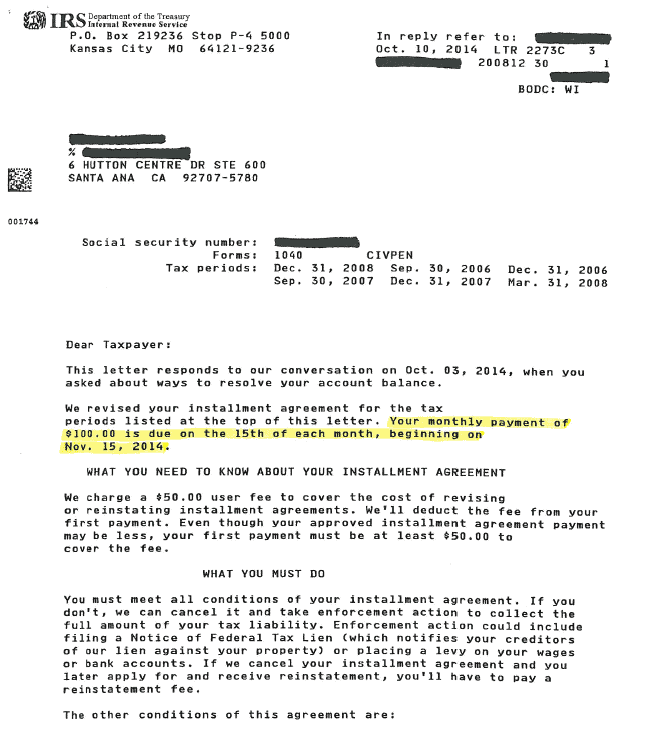
- A request for an installment agreement while it is pending or is rejected, with limited additional time.
- A bankruptcy case, plus an additional period after it closes. See bankruptcy and tax debt.
- Time spent outside the country for a continuous stretch, under the rules in the manual.
- A request for innocent spouse relief, which can affect the time the IRS has against the requesting spouse. See innocent spouse relief.
Because each event adds time, an old balance may expire later than the simple ten year count suggests. We read the account transcript to see the transaction codes that mark each suspension. The IRS manual itself notes that its guidance cannot cover every case, so a manual calculation from a transcript is worth double checking.
How do I find my CSED?
Start with an IRS account transcript for each year. The IRS Get Transcript tool lets you request them. The transcript shows the date of assessment and transaction codes for events such as an offer, a hearing request or a bankruptcy. Add ten years to the assessment date, then add the days of each suspension. An IRS representative can also give you a date, and we compare it to our own calculation because errors happen.

Should I just wait out the statute?
Usually not as a plan. While the clock runs, interest and penalties continue, and the IRS can use a federal tax lien, levy bank accounts, garnish wages and keep your refunds. A short waiting period may make sense for someone who is truly near expiration and has no assets to reach. But filing an offer in compromise or a hearing request can pause the clock, which is the opposite of what a waiting strategy wants. That is why we build the plan around the date. In some cases we pursue currently not collectible status to hold the IRS off without adding time, and in others a settlement through an offer in compromise or an installment agreement is the better route, because the extra time is a fair trade for the protection.
Installment agreements can be shaped to the statute as well. A balance that is close to expiring may be better handled with a smaller payment plan than one that locks in years of payments, and we tell clients when that makes sense. We never advise ignoring the IRS, and we do not suggest that any debt will disappear on its own.
What about the limit on assessing tax?
The collection statute is separate from the assessment statute. The IRS generally has a limited time after a return is filed to assess more tax, and the clock for assessment does not start until a return is filed. That is a major reason to file overdue returns carefully, and why we look closely at the facts before filing old years, as explained on our page for unfiled tax returns. Late filing can also create new assessments, which carry their own ten years. If you are thinking about a very old year, speak with us before filing.
Does the statute matter for state debt?
Arizona has its own time limits for collecting state tax, and they are different from the federal rules. We do not apply the federal ten year rule to a state balance. See our page on Arizona state tax debt, and note that any question about state limitation periods should be reviewed with an attorney who can confirm the statute that applies to your type of tax.
How we analyze your CSED
We obtain transcripts for each tax year, build a timeline of assessments and suspensions, and identify each expiration date. We then show you the dates next to the balance and discuss which paths make sense. If a date is close, we protect it from accidental extension. If it is far, we focus on finding a resolution. We also coordinate with any revenue officer already involved, because the officer's actions and the dates are tied together. Our team is based in Tucson and serves clients across Arizona by phone and secure portal. You can read about our team or request a callback to start with a transcript review. We do not promise that a debt will expire or that the IRS will agree with our calculation, You will see the dates and how we got them.
Why an accurate date helps even if you plan to pay
Knowing the expiration date gives you a stronger position and some perspective. It tells you which years are most urgent, which are close to falling off, and which are worth settling now. It also stops you from signing an agreement that waives the statute or extends it without understanding the cost. The IRS can ask you to agree to an extension in some situations, such as when it grants a longer installment agreement, and that decision should be made deliberately. We review any request of that kind before you sign. If you have older tax years that are unassessed, the plan is different, because the IRS may still be able to assess them, and the quiet period has not begun. Whichever situation you are in, the first step is the same: get transcripts and build the timeline.
Frequently asked questions
How long does the IRS have to collect a tax debt?
Generally 10 years from the date the tax is assessed. That deadline is the Collection Statute Expiration Date, and each assessed tax year has its own date.
Does the 10 year clock ever stop?
Yes. Events such as a pending offer in compromise, a Collection Due Process hearing request, a pending installment agreement request or a bankruptcy case can pause the clock and extend the date.
How can I find my CSED?
Request your IRS account transcripts. They show the assessment date and transaction codes for suspensions. Add ten years to the assessment date and then add the suspension periods.
Should I wait for the statute to expire?
Usually not as a strategy. The IRS can collect while the clock runs, and interest and penalties keep growing. Some actions also pause the clock. We review each case before advising.
Does filing a late return restart the clock?
Filing a late return can lead to a new assessment, and each assessment has its own collection period. That is why we review old years before filing.
Is the Arizona state collection period the same as the federal one?
No. State time limits are separate and depend on the tax type. We flag any state limitation question for attorney review.
Ready to resolve this? As the tax attorney team Tucson and Arizona trust, we offer a free consultation with a resolution specialist, available by phone Monday through Friday. Request a callback or call (520) 900-1422.
This page is for general information and is not legal advice. Every tax matter is different, outcomes depend on the facts, and nothing here guarantees a result. Contacting Southwest Tax Law does not create an attorney-client relationship.
Other Ways We Can Help
Visit Southwest Tax Law
Get your free tax debt action plan.
15 minutes with our resolution team. A concrete plan, yours to keep. No obligation, no pressure.